
Why You Shouldn’t Substitute Yarn Weights When Knitting a Sweater
I watch a lot of knitting podcasts while I knit, and every so often one of the podcasters will decide to knit a sweater with a yarn that is an entirely different weight than the one recommended in the pattern. They will take a pattern written for, say, a worsted weight yarn and knit it in a fingering weight instead.
It looks fun and creative and begs the question:
Is it okay to change yarn weight in a sweater pattern?
As a knitting pattern designer, I say: please don’t.
There’s no judgement if you decide to change yarn weight. Just understand that doing so means you’re no longer following the pattern as written, and the responsibility for recalculating fit shifts to you.
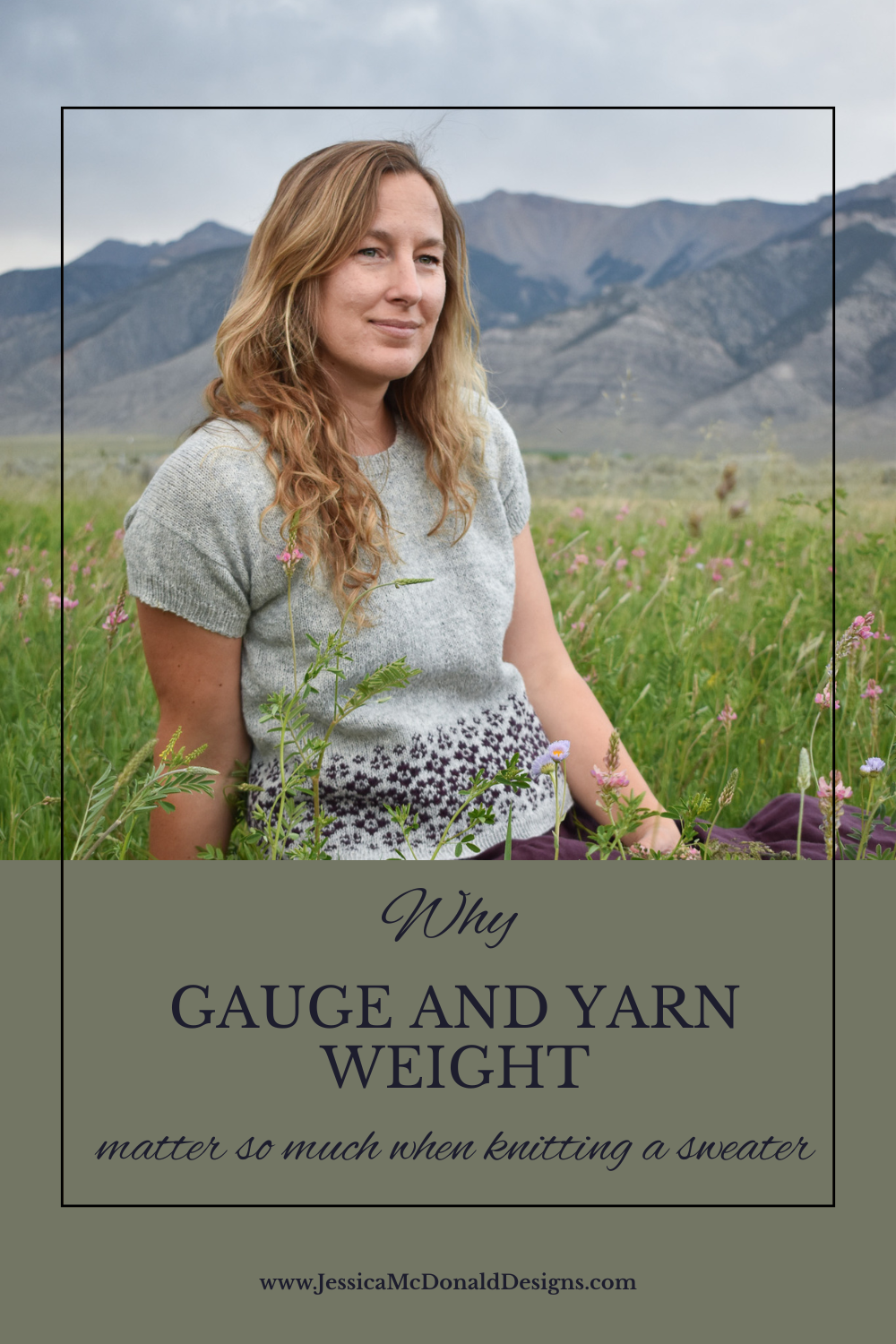
Substituting a yarn in a knitting pattern is a normal thing, but changing to an entirely different weight of yarn and knitting a sweater without matching gauge is another thing entirely.
At first glance, the process seems so simple. Figure out your desired chest circumference, take the gauge you get with the yarn you want to use and do the math to figure out how many stitches you need to get that circumference at that gauge. And then choose the size with the closest number of stitches in the body.
This approach focuses only on chest circumference and overlooks many other measurements that affect sweater fit. When I am grading and writing a sweater pattern, the chest circumference is not the only number that matters. It is just on one of many, many important numbers.
So, what happens if you knit a sweater without matching gauge?
There are three main issues:
1 – The neckline will not fit right
2 – The yoke depth is going to be wrong
3 – The sleeve decrease math will be all messed up
Let’s get into all three in even greater detail:
1 – Why changing yarn weight and gauge ruins sweater neckline fit
For a top-down circular yoke sweater, you are casting on a certain number of stitches to get (usually) a crew neckline. To get a 19-inch neck opening (a close-fitting crew neck), you will need 118 stitches in a fingering weight yarn and 94 stitches in a DK weight yarn. Leaving the cast-on number the same and moving to a new yarn weight will either give you a neckline that is way too big or one so tight it doesn’t fit over your head. And changing the cast on number means you have to re-calculate the entire yoke because all the math grows out from that starting number.
For a shaped neckline such as a top-down raglan pullover, your back neck stitches are calculated very carefully to give you a neckline that sits neatly and frames your face beautifully. If you change the yarn weight, you’ve thrown all that careful math out the window and now your neckline may be too wide or too narrow. To get a good fit, you will have to re-calculate the cast on numbers to make sure your back neck width is right, and then you will have to re-calculate the increases so that they work out nicely too.
Then there is also the depth of the neckline. Again, this is very carefully calculated so that it sits at the perfect depth. Too many rows, and it sits awkwardly low. Too few rows, and you are getting strangled by your sweater. Changing your yarn weight also changes your row gauge dramatically, and your neckline depth will be all out of whack. The neckline frames your face. It is the part of the sweater that people will see first, and if it doesn’t sit right, your whole sweater will look wonky and ill-made.
2 – How yarn weight and row gauge affect sweater yoke depth
As I just said, changing your yarn weight also changes your row gauge. When I am designing a new colorwork yoke, I first look at my row gauge and desired yoke depth. Then I know how many rows I can design the motif over. If you change the yarn weight and, therefore, row gauge, you will end up with a yoke that is either way too deep or your colorwork will end well before the yoke is deep enough.
So, you either need to decide where to whack off part of the chart or decide to be happy with a colorwork “collar” instead of a colorwork yoke, and neither option will look like the original design.
And it isn’t just the colorwork motif that will be messed up. I intentionally place the increases inside the yoke. Too high and your yoke ripples weirdly. Too low and your yoke rides up. The increases need to be placed in just the right spots to make the yoke fall smoothly over your shoulders. Dramatically changing row gauge also dramatically changes the placement of the increases. You run a very real risk of ending up with a yoke that sits awkwardly on your shoulders.
3 – Sleeve fit problems caused by wrong gauge in sweaters
The sleeve decrease math is fairly straightforward. Upper sleeve stitches – desired cuff stitches = stitches to decrease. Divide by two and you get your number of decrease rounds.
Where you end up knocked off course is how often you work those decrease rounds. I use row gauge to determine how many rounds will be in the sleeve and divide that by the number of decrease rounds so I can tell you how often to decrease. If you change the row gauge, you are also changing how many rounds the sleeve will take to knit, which means you will need to completely re-calculate how often to work the decrease rounds.
When you are knitting a sweater, gauge matters. If you want your handknit sweater to fit you nicely, you need to follow the designers gauge and yarn recommendation. Otherwise, you will be on ChatGPT typing in “why doesn’t my knitted sweater fit?”
Changing gauge in a sweater pattern means you are stepping outside the math the pattern is based on, and the fit results will be unpredictable. For the best results, I always recommend using a yarn that matches the intended gauge.
One of the main benefits of buying a sweater pattern is having all the math already done for you. The designer (aka, me) spends hours making sure the beauty of the design elements pair harmoniously with good fit, so you don’t ever have to worry about the math. You can just knit and enjoy the process and end up with a beautiful handknit sweater that fits you properly.
So, if you would like to knit a sweater where the math is already done for you, you can explore my sweater patterns at the links below.